
For years, scientists believed that oceans were the primary source of airborne microplastics. However, a groundbreaking new study has upended this assumption—revealing that land-based sources may emit over 20 times more microplastic particles into the atmosphere than oceans.
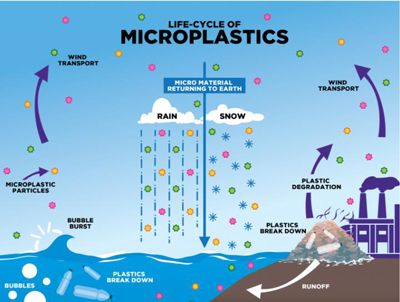
This discovery not only challenges long-standing scientific models but also raises critical questions about global pollution pathways, policy priorities, and human exposure risks.
Microplastics are tiny plastic particles (less than 5 mm in size) generated either directly (e.g., microbeads) or through the breakdown of larger plastics like bottles, tires, and textiles.
While traditionally studied in oceans and soils, recent research shows that microplastics are also widespread in the atmosphere, capable of traveling long distances and reaching even remote regions like mountains and polar areas.
Airborne microplastics matter because they:
A 2026 study published in Nature combined 2,700+ global measurements with atmospheric modeling to reassess microplastic emissions.
This means earlier research may have misidentified the dominant source of airborne microplastics, potentially skewing environmental strategies for years.
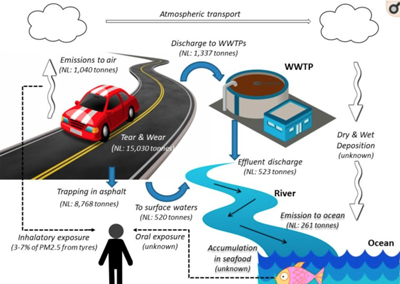
In urban Europe, studies show tire particles can account for over 90% of airborne microplastic mass in some areas.
Indoor environments can contain hundreds of microplastic particles per cubic meter, making them a major exposure zone.
Previously deposited plastics in soil and dust can be re-lifted into the air by wind, creating a continuous pollution cycle.
One of the most alarming insights is how microplastics move globally:
This confirms that microplastic pollution is not local—it is planetary.
Emerging evidence suggests that airborne microplastics may pose serious health risks:
Although research is still evolving, the shift toward airborne exposure highlights a previously underestimated pathway of human risk.
This new understanding has major consequences for environmental policy:
If land is the dominant source, policies must prioritize:
The study highlights inconsistencies in measurement methods, calling for:
Microplastics should be treated not just as waste—but as airborne pollutants, linking plastic regulation with air quality standards.
This dual pattern underscores the need for both local mitigation and global cooperation.
This study doesn’t eliminate the microplastic crisis—it reframes it.
While earlier estimates may have overstated some quantities, the reality is clear:
The “microplastics mystery” is far from fully solved—but this research marks a critical step forward.
By revealing that airborne microplastics originate primarily from land—and at far greater levels than expected— it forces a rethink of how we approach pollution, from scientific models to global policy.
The next challenge is clear:
👉 Shift from measuring the problem to actively reducing it at its source.
Anhui Province Academy of Science and Technology, No. 128,Wanshui Road, Hi-Tech Zone, Hefei City, Anhui Province, China
 +86 17354022649
 service@sondii.com


 IPv6 RÉSEAU PRIS EN CHARGE
Nos horaires
Lundi 21/11 - Mer 23/11 : 9h - 20h
Jeu. 24/11 : fermé - Joyeux Thanksgiving !
Vendredi 25/11 : 8h00 - 22h00
Sam 26/11 - Dim 27/11 : 10h - 21h
(toutes les heures sont l'heure de l'Est)